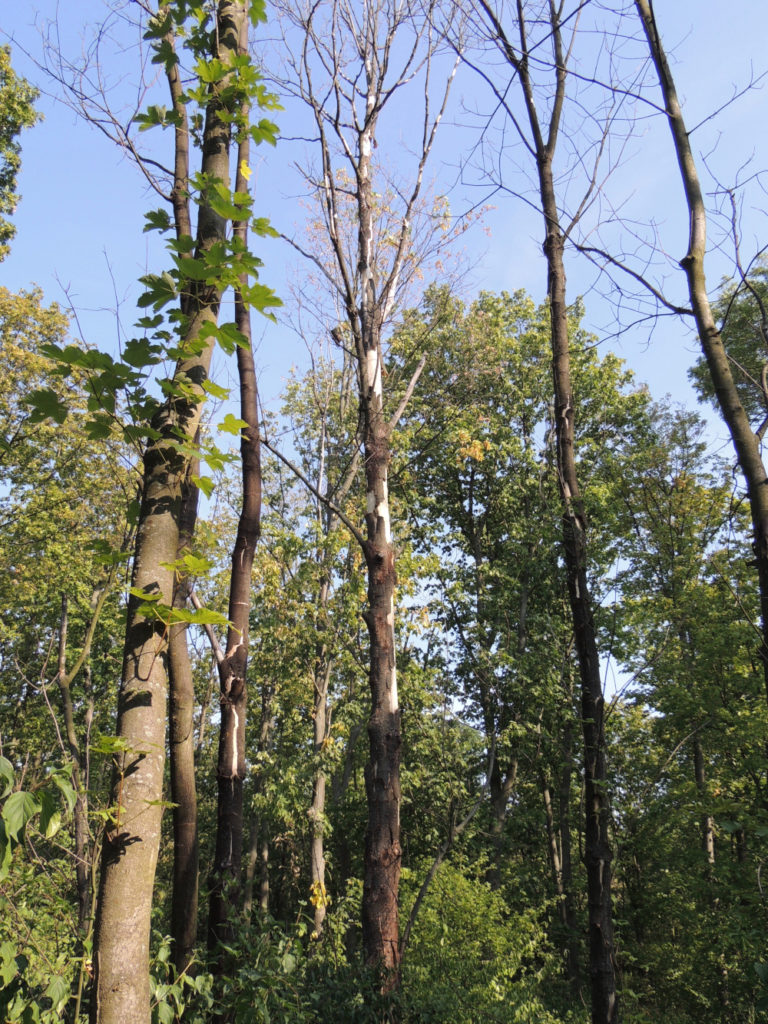
Fir, pine, maple and oak have a high tolerance to heat and drought. Nevertheless, there is currently an increased occurrence of a number of pests and pathogens on these "tree species of the future". In the "CLIFF" project, knowledge about these organisms is to be expanded.
The BML commissioned a consortium with the participation of the Austrian Research Center of Forests (BFW) with the project "FORSITE II - Development of the ecological basis for a dynamic forest typing in Upper Austria, Lower Austria and Burgenland".
In this policy brief we propose measures to maintain the forest carbon sink strength and provide information for the time horizons for achieving the targets
Climate change is likely to alter the future growth capacity of European forests in providing vital ecosystem services. Adaptive management aiming at reducing vulnerability and enhancing the resilience of forest ecosystems is a key to preserve the potential of forests.
Pause for a moment and think about what type of landscape the terms “nature” or “naturalness” evokein you. It’s quite possible that a forest will appear in front of your mind’s eye. The forest is likeable and, one could argue, constitutes a complex backdrop. It is made of numerous spatial and temporal planes that are […]
The first Inter-Alpine Natural Hazards Conference (INAC) took place in Innsbruck from May 5 to 7, 2025. Over 100 experts from Austria, Germany, France, Italy, Norway and Switzerland participated in the event. They came from the fields of science, industry, infrastructure and technology.
Global warming is forcing forest owners to adapt their forests to future climatic conditions. In the course of forest conversion, the future of the forest is to be secured with new tree species or combinations. But climate fitness is not the only goal: forests should be profitable, have a high level of biodiversity and also act as a greenhouse gas sink. How to reconcile all this is the focus of the two-year ACRP research project ManageBeech.
The national forest biodiversity index is an aggregate of suitable indicators based on the criteria reliability, validity and objectivity. The outcomes show a relatively high score for Austrian.
Science and practice from across Europe are joining forces under the leadership of the European Forest Institute to ensure the long-term development of biodiversity and ecosystem services of our forests. The Austrian Research Centre for Forests (BFW) is contributing its expertise in silviculture, genetics and conservation in regeneration and afforestation measures to this effort.
Ethiopia has embarked on one of the globally most ambitious programs of forest landscape restoration (FLR) with a commitment to restore more than 20 million hectare of degraded forest landscapes within the next 20 years
Robinia, Douglas fir and red oak were introduced to Europe several hundred years ago and are among the 530 tree species that are non-native to Europe. The international ALPTREES project has developed a risk assessment system for this purpose and published manuals on the management of non-native tree species in forests and urban areas.
Microsoft will no longer support Internet Explorer. Therefore please download a modern browser to view the BFW website.